
The Italian fashion industry continues to confirm its position as one of Europe’s leading hubs for the sector. According to data presented during the SAMAB 2026 International Congress, the fashion industry generated revenues of €87.4 billion in 2025. The apparel sector alone was worth €40 billion, with exports reaching €27.3 billion, reaffirming its role as one of the pillars of Italy’s manufacturing economy.
In terms of business activity, as of the first quarter of 2026, Italy’s clothing manufacturing industry comprised nearly 37,100 active companies, employing more than 196,700 people. Tuscany remains the leading region by number of companies, with 7,645 active businesses, accounting for 20.6% of the national total for the sector. It is followed by Lombardy (5,608 companies), Campania (4,300), Veneto (3,804), Emilia-Romagna (3,342) and Puglia (2,293).
For a sector that continues to play a strategic role in the success of Made in Italy, embracing innovation is no longer an option but a necessity. Automation, process digitalisation, artificial intelligence, Big Data, the Internet of Things (IoT), digital twins and real-time monitoring systems are transforming the way fashion companies respond to evolving market demands.
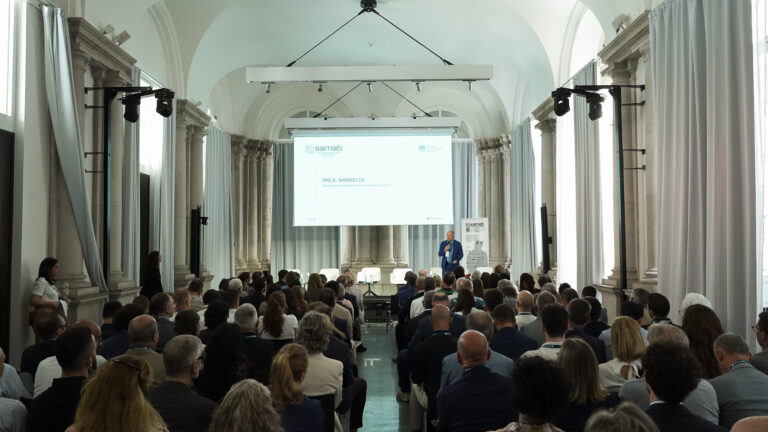
The strategic importance of technology was a key theme that emerged today in Milan during the SAMAB 2026 International Congress, which once again served as a platform for dialogue among institutions, industry leaders and innovation experts on the future of the fashion supply chain. The event also marked an important milestone on the road to the next edition of SAMAB – Fashion Technologies Event, scheduled to take place from 25 to 27 May 2027 at Fiera Milano Rho.
Organised by Senaf in collaboration with Tecniche Nuove Group and with Technofashion magazine as media partner, the Congress is held under the patronage of ANTIA – the Italian National Association of Fashion System Technicians and Professionals, Confindustria Moda – the Italian Textile and Fashion Federation, and IACDE – the International Association of Clothing Designers and Executives, with the support of PwC Italy.
A very clear message emerged from the Congress: for fashion industry entrepreneurs, investing in innovation is no longer an option. The objective is not to replace the craftsmanship and expertise that define Made in Italy, but to enhance and expand its potential by making production processes more efficient, traceable, flexible and sustainable.
What are the tangible benefits of innovation?
According to the market analysis presented by PwC Italy, technology has become one of the key drivers of competitiveness across the fashion supply chain. Companies that are leaner, more efficient and better equipped technologically will be able to respond more quickly to ongoing market changes, improving decision-making, optimising planning processes, reducing waste, shortening time-to-market and strengthening control across the entire value chain.
This trend is also reflected in the growth of Internet of Things (IoT) technologies. According to the Politecnico di Milano Observatory, the Italian IoT market reached €10.9 billion in 2025, confirming the increasing adoption of digital solutions within industrial processes.
Alongside these opportunities, significant challenges remain. For many companies—particularly small and medium-sized enterprises (SMEs)—the adoption of new technologies is still hindered by high initial investment costs, a shortage of specialized skills, difficulties in integrating new solutions with existing systems and, not least, a cultural mindset that often views technology as a cost rather than a strategic investment.
These challenges are further compounded by evolving market expectations and increasingly stringent European regulations relating to sustainability, traceability, supply chain transparency and the reduction of environmental impact.
Against this backdrop, SAMAB serves as a practical platform for dialogue and collaboration, supporting the ongoing evolution of fashion manufacturing. By fostering exchange among industry leaders, institutions and innovation stakeholders, the event highlights the value of technologies applied to fashion production and contributes to strengthening the competitiveness of Italian and European companies in international markets.
“With the SAMAB 2026 International Congress, our goal was to create a meaningful forum for discussion for a supply chain undergoing profound transformation, where technology, skills and manufacturing culture are becoming increasingly interconnected,” said Ivo Alfonso Nardella, President of Tecniche Nuove Group and Senaf.
“The Italian fashion industry possesses extraordinary strengths rooted in craftsmanship, manufacturing excellence and the ability of companies to anticipate and respond to market changes. Today, however, maintaining international competitiveness requires complementing these assets with tools that can make processes more efficient, helping businesses innovate, reduce waste, improve quality and respond more rapidly to evolving market demands.
This is precisely why SAMAB was created: to serve as a platform for dialogue between industry, institutions and innovation, supporting entrepreneurs and companies in their growth and development journey”.
“At a time when markets are undergoing profound transformation, the most successful business models are those built on deep vertical integration across the entire value chain, from raw materials to the end customer,” said Marc Sondermann, Chairman of CEO Circle and moderator of the Congress.
“Companies that are able to leverage the manufacturing strengths of Made in Italy through a direct-to-market approach—communicating their value directly to consumers and converting interest into sales—gain a significant competitive advantage when it comes to designing collections, planning production and allocating products across distribution channels.
Avoiding the misallocation of production capacity and inventory has always been one of the most critical success factors underpinning the financial performance of Italy’s manufacturing excellence.”
CONGRESS HIGHLIGHTS
The Congress opened with welcome remarks by Ivo A. Nardella, President of Tecniche Nuove Group and Senaf.
The morning programme began with a market overview presented by Omar Cadamuro, Fashion Leader and Partner at PwC Italy, focusing on the key trends shaping the fashion supply chain and their potential impact on the industry.
The programme then continued with a keynote speech by Alfonso Dolce, President of Dolce&Gabbana, followed by an institutional roundtable discussion dedicated to internationalisation policies and the promotion of Made in Italy manufacturing. Participants included Luca Sburlati, President of Confindustria Moda, Roberto Luongo, Advisor to the Minister for Internationalisation and the Promotion of Made in Italy, and Carlo Capasa, President of the National Chamber for Italian Fashion.
The morning continued with an industry roundtable focused on supply chain developments and corporate strategies, featuring David Franzini, Brand Director Apparel & Leather Accessories at Zegna Group, and Marco Angeloni, CEO & Chairman of Raffaele Caruso S.p.A.
A significant part of the programme was devoted to technological innovation, with a roundtable exploring emerging technologies and practical applications of artificial intelligence in manufacturing processes. Following the presentation “A Journey into AI” by Fabio Ferrari, Founder of NUDE Cultural Hub, contributions were delivered by Francesco Meoni, Chief Technical Officer at BI-REX Competence Center for Big Data and Industry 4.0 Technologies, and Mauro Sampellegrini, Director of Research and Innovation at Confindustria Moda. The session concluded with a Q&A discussion, followed by a networking lunch.
At a time when fashion manufacturing is required to combine technical expertise, industrial vision and a strong capacity for innovation, SAMAB continues to serve as a valuable platform for dialogue and collaboration, supporting the evolution of the entire supply chain.
The Congress highlighted how the future of Made in Italy depends on the ability to bring together creativity, manufacturing excellence and advanced technologies. By fostering this integration, Italian companies can strengthen their position in international markets while promoting increasingly efficient, sustainable and competitive production models.
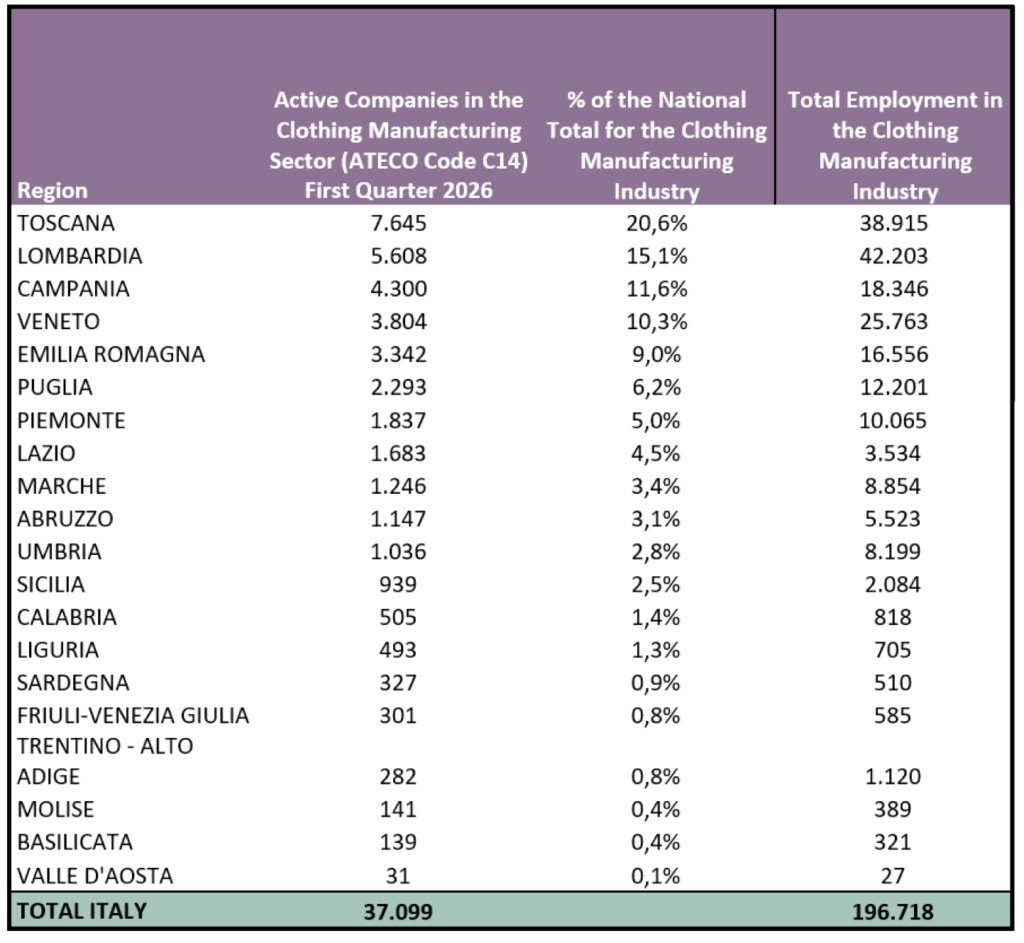
Source: Author’s elaboration based on data from the Italian Chambers of Commerce Business Register for Q1 2026, referring to ATECO Code C14 (Manufacture of Wearing Apparel).
SAMAB
SAMAB – Fashion Technologies Event is the international exhibition dedicated to technological innovation for the fashion supply chain. Organised by Senaf in collaboration with Tecniche Nuove Group and the industry magazine Technofashion, under the patronage of ANTIA – the Italian National Association of Fashion System Technicians and Professionals, Confindustria Moda – the Italian Textile and Fashion Federation, and IACDE – the International Association of Clothing Designers and Executives, and with the support of PwC Italy, SAMAB is a key reference point for companies, artisans and industry professionals.
Through a comprehensive exhibition area, specialised workshops, B2B meetings and networking opportunities, SAMAB offers a unique platform for discovering the latest textile processing technologies, next-generation machinery and digital solutions that are transforming the fashion industry. The event promotes the competitiveness of Italian and European companies, encouraging engagement with international markets and supporting the sector’s transition towards more efficient and sustainable manufacturing processes.
The first edition of SAMAB took place in Milan from 27 to 29 May 2025 at Superstudio Maxi. The second exhibition edition will be held from 25 to 27 May 2027 at Fiera Milano Rho.
For more information, please click here
Ufficio stampa MY PR
Roberto Grattagliano – 338 9291793 – roberto.grattagliano@mypr.it
Marta Rutigliano – 350397141 – marta.rutigliano@mypr.it
Claudia Frasson – 3427569494 – claudia.frasson@mypr.it